
Industry
Local Government
Challenge
The City of Hobart needed a consistent, city-wide baseline to understand where tree canopy was distributed, how it changed between 2017 and 2022, and where urban greening efforts should be prioritised.
Results
Geoneon’s satellite-based canopy mapping supported the City of Hobart’s State of the Canopy report with comparable 2017 and 2022 evidence. The City reported a two per cent loss of canopy on private land, while public-land canopy remained broadly stable, and used suburb and planning-zone breakdowns to guide targeted urban greening.
Key Product
Geoneon Vegetation
About
The City of Hobart is responsible for urban planning, public spaces and environmental management across Tasmania’s capital.
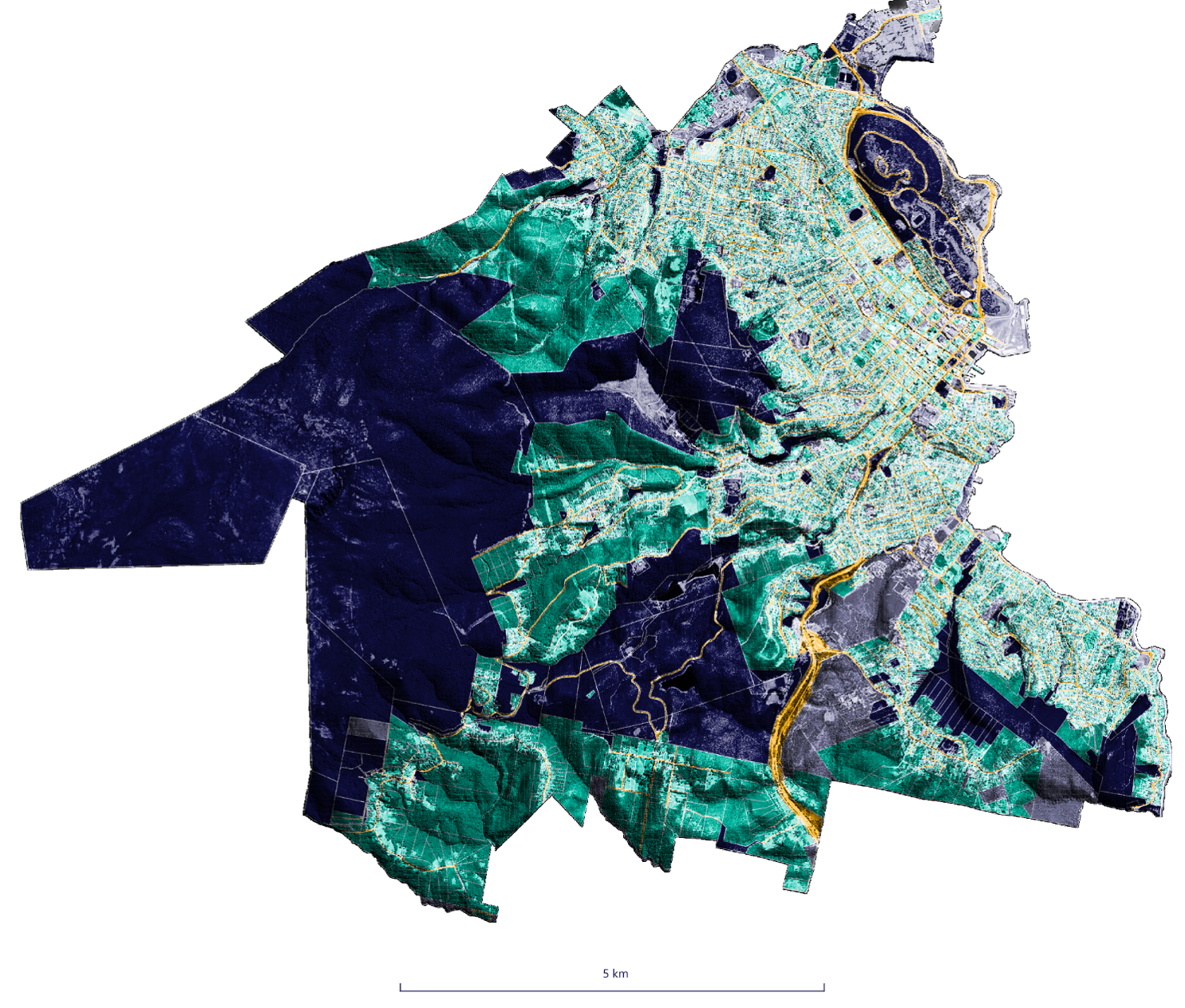
This case study covers city-wide urban canopy monitoring in Hobart, Tasmania. Geoneon delivered satellite-based canopy mapping and analysis to support the City’s urban forest planning and State of the Canopy report.
The Challenge
Tree canopy supports liveability, biodiversity and climate response, but city-wide planning requires consistent evidence of where canopy is located and how it changes over time.
The City of Hobart needed a comparable baseline that could show:
- the distribution of tree canopy across the municipality;
- where canopy increased or decreased between 2017 and 2022; and
- how patterns varied across suburbs, planning zones and land types.
The work needed to help identify where closer review or targeted urban greening may be warranted.
What Geoneon did
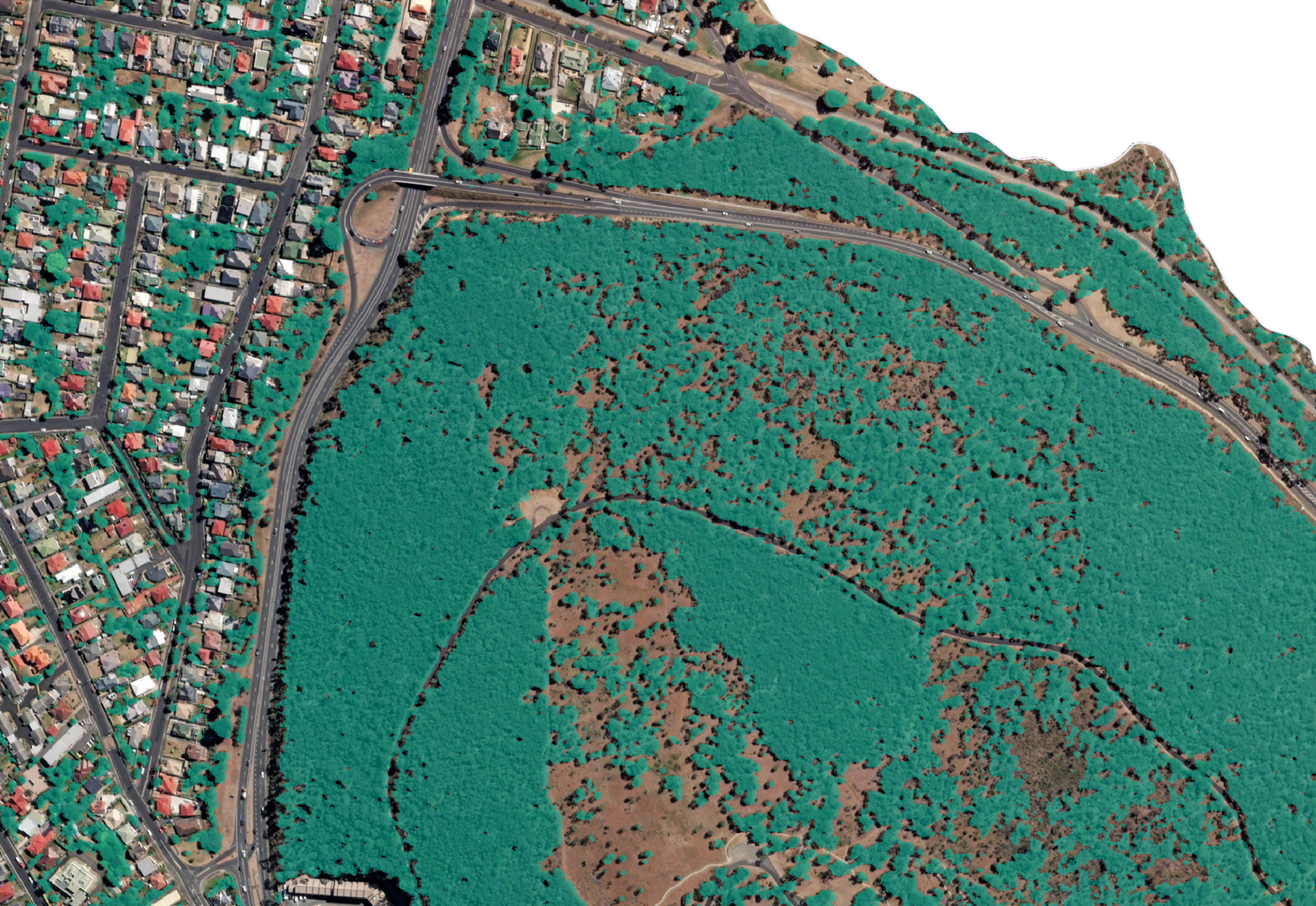
Geoneon used high-resolution satellite imagery and machine-learning classification to map tree canopy for 2017 and 2022. The datasets were processed consistently so canopy change could be compared across the municipality.
The analysis enabled canopy evidence to be:
- mapped consistently across the study area;
- compared between the two observation years; and
- summarised by suburb, planning zone and land type.
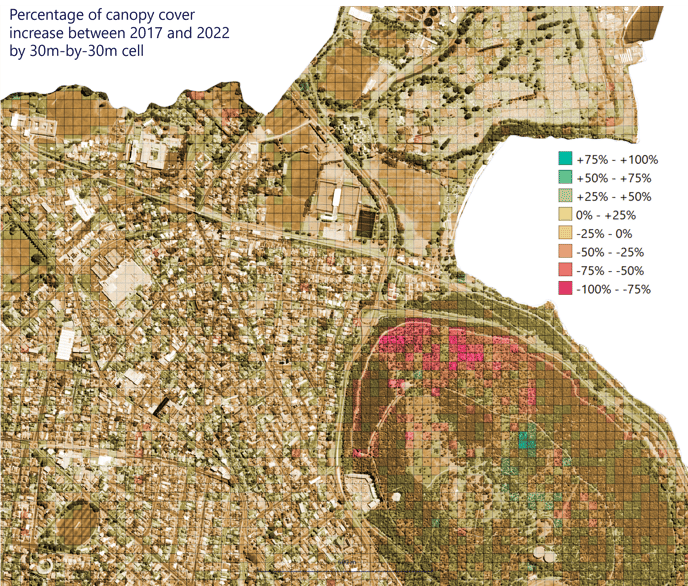
The work informed the City of Hobart’s State of the Canopy report, which provides a five-year view of tree canopy change across Hobart.
Key findings
The City’s published report records:
- 54.6 hectares of canopy loss on urban private land between 2017 and 2022, from 509.3 to 454.7 hectares;
- urban public-land canopy remaining broadly stable, changing from 401.6 to 401.7 hectares;
- areas of both canopy increase and decrease across the city; and
- results that could be broken down by suburb and planning zone.
The City summarises the private-land change as a two per cent loss over five years.
Decision value
The mapping provides a consistent evidence base for identifying areas of canopy decline and supporting more targeted urban greening. The City states that the report will guide community education, incentives and further research, while supporting progress towards its target of 40 per cent canopy cover across Hobart’s urban areas by 2046.
Interpretation boundary
The mapping compares classified canopy at two observation dates. It identifies where canopy cover changed, but does not by itself establish why individual trees were gained or lost or predict future canopy conditions. Results should be interpreted at the spatial scale and land classifications used in the City’s report.
Acknowledgements
Commissioned by the City of Hobart. Canopy mapping and analysis by Geoneon. Findings published in the City of Hobart’s State of the Canopy report.
Have a project or question in mind?